Thirty Positions, Two Names
The last story was about the outcome. About Leyla Yenirce, who receives the Art Prize of the SPD parliamentary group of Lower Saxony in 2026, and about eleven people who decided together. This story takes a step back. It tells of the weeks before, when nothing had been decided yet.
Each jury member could submit one proposal by June 22, two at most. That sounds like little work, two names come to mind quickly. But I was not sitting there for myself. I was sitting there for the BBK Lower Saxony, and so for a great many artists in this state. A voice on the jury is only as good as the work before it.
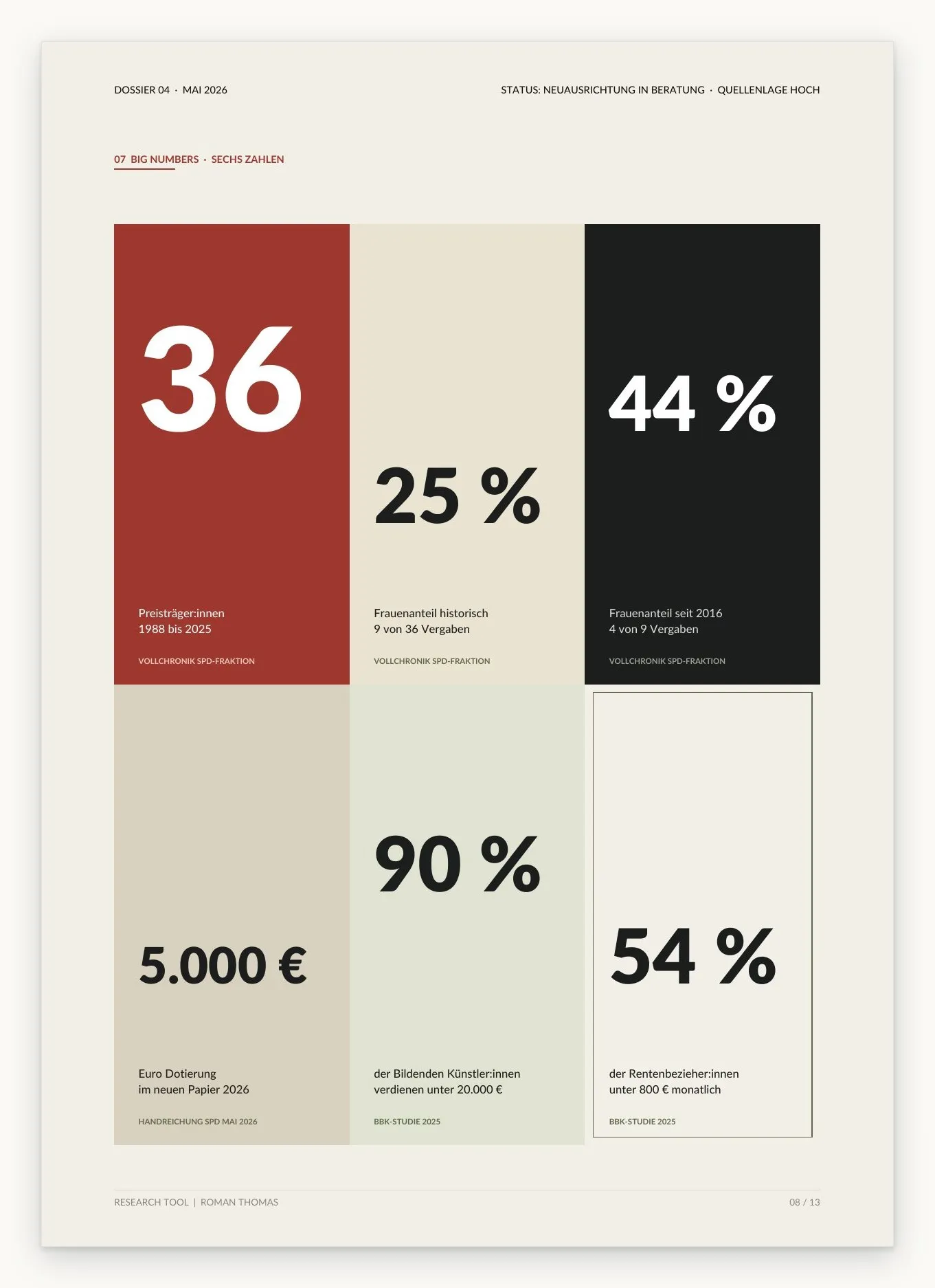
Before looking for names, I looked at the prize itself. It has been awarded since 1988, exactly 36 times up to 2025, with no award in 1991 and 2022. Nine of those 36 prizes went to women, a quarter. Since 2016 things look different, four out of nine. The basis was the complete list of winners that the parliamentary group gave us at the first session on May 28.
Then there were figures that have nothing to do with the prize and yet a great deal. The 2025 study “Von der Kunst zu leben” by the BBK federal association shows that 90 percent of visual artists earn less than 20,000 euros a year. Anyone helping to decide on a prize for the middle of a career should know what that middle looks like in everyday life.
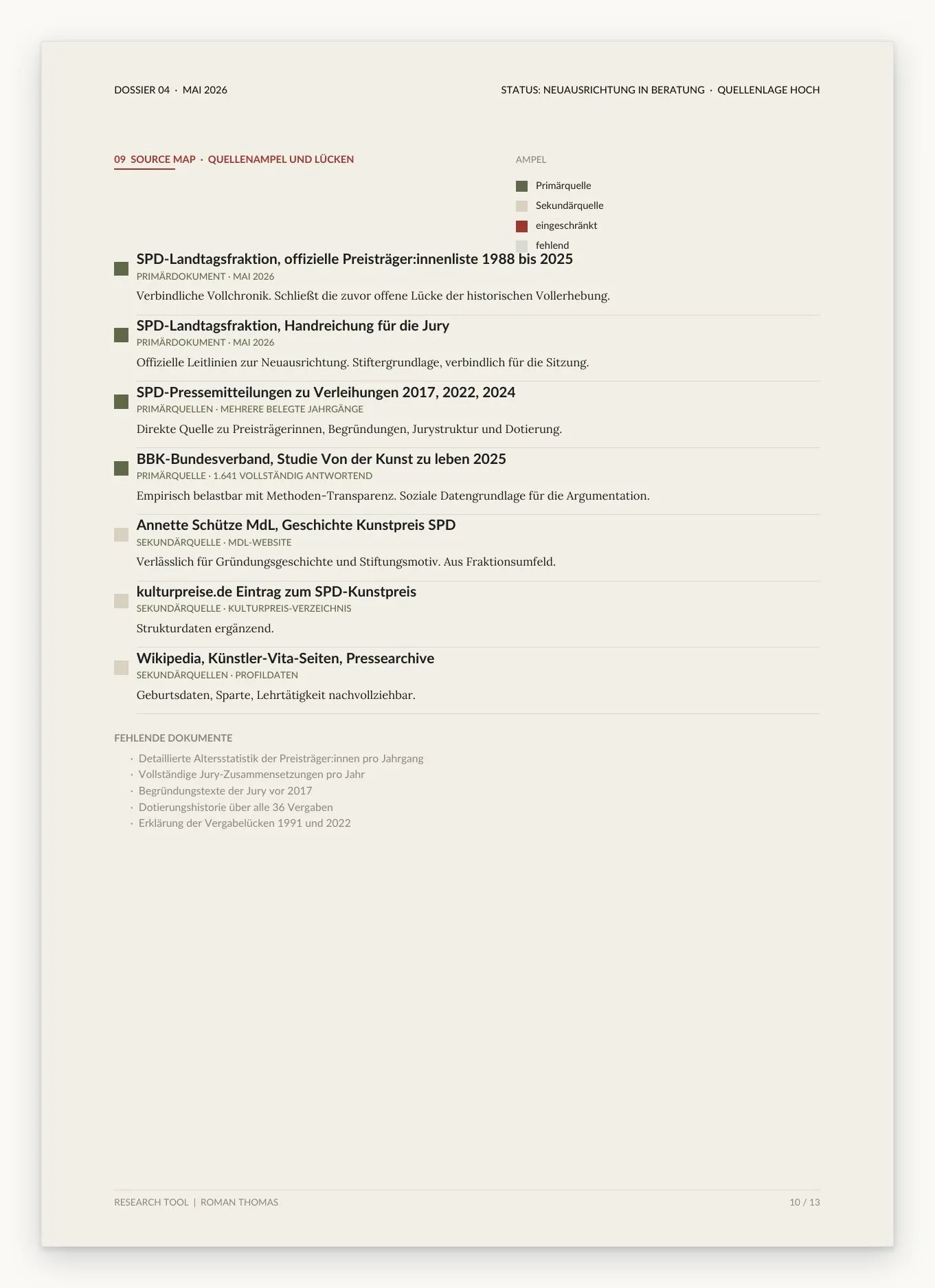
Then the actual search. Where do you find artists who live, work or exhibit in Lower Saxony and stand in the middle of their path? In the end there were 24 sources: the annual grants of the Ministry of Culture, the Sprengel Prize of the Lower Saxony Savings Banks Foundation, the autumn exhibition of Kunstverein Hannover, the Braunschweig University of Art, exhibitions at the museums in Oldenburg and Osnabrück, and the member directories of the BBK districts in Hanover, Braunschweig, Lüneburg and southern Lower Saxony.
A fixed order applied. Official bodies first, then associations, then the artist's own website, social media last. Every piece of information got its source, and whatever could not be verified stayed marked as open. The connection to Lower Saxony was weighted too. Someone who lives and works here counts for more than someone who exhibited here once or was born here.
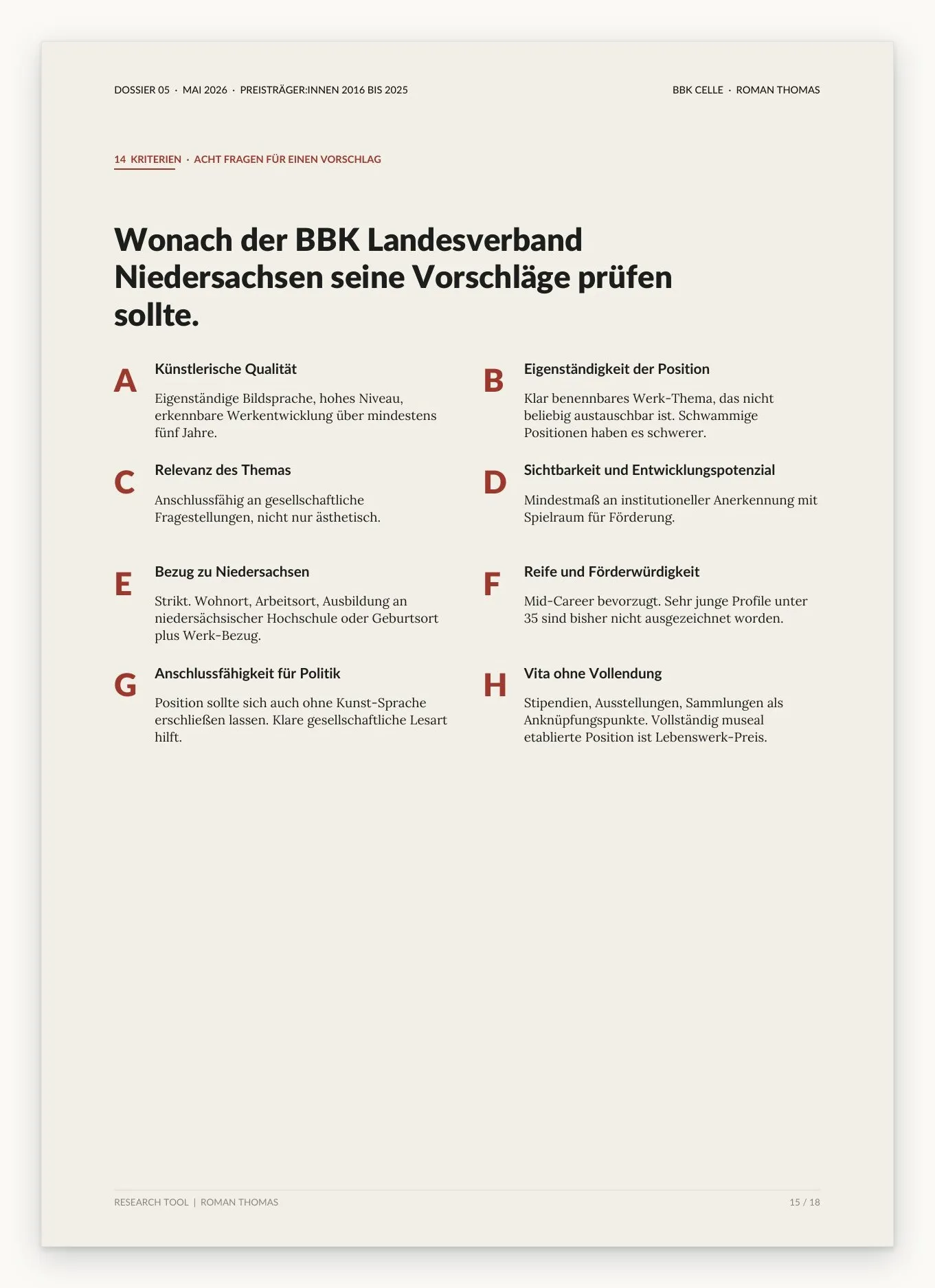
After the first round there were more than thirty positions on my list. Too many to compare seriously, and too many to simply cross out. So I wrote test questions, eight of them. Does the work have its own visual language? Is the position distinctive? How strong is the connection to Lower Saxony? Is someone really in the middle of their path, or is the CV already complete? And would a prize be meaningful support right now?
More than thirty positions became sixteen. Each had a page with a work image, place, medium and verified milestones, plus a note on whether the person is a member of the BBK. Ten of the sixteen were, spread across five districts. The names stay out of this story. They belong to the jury, not to the internet.
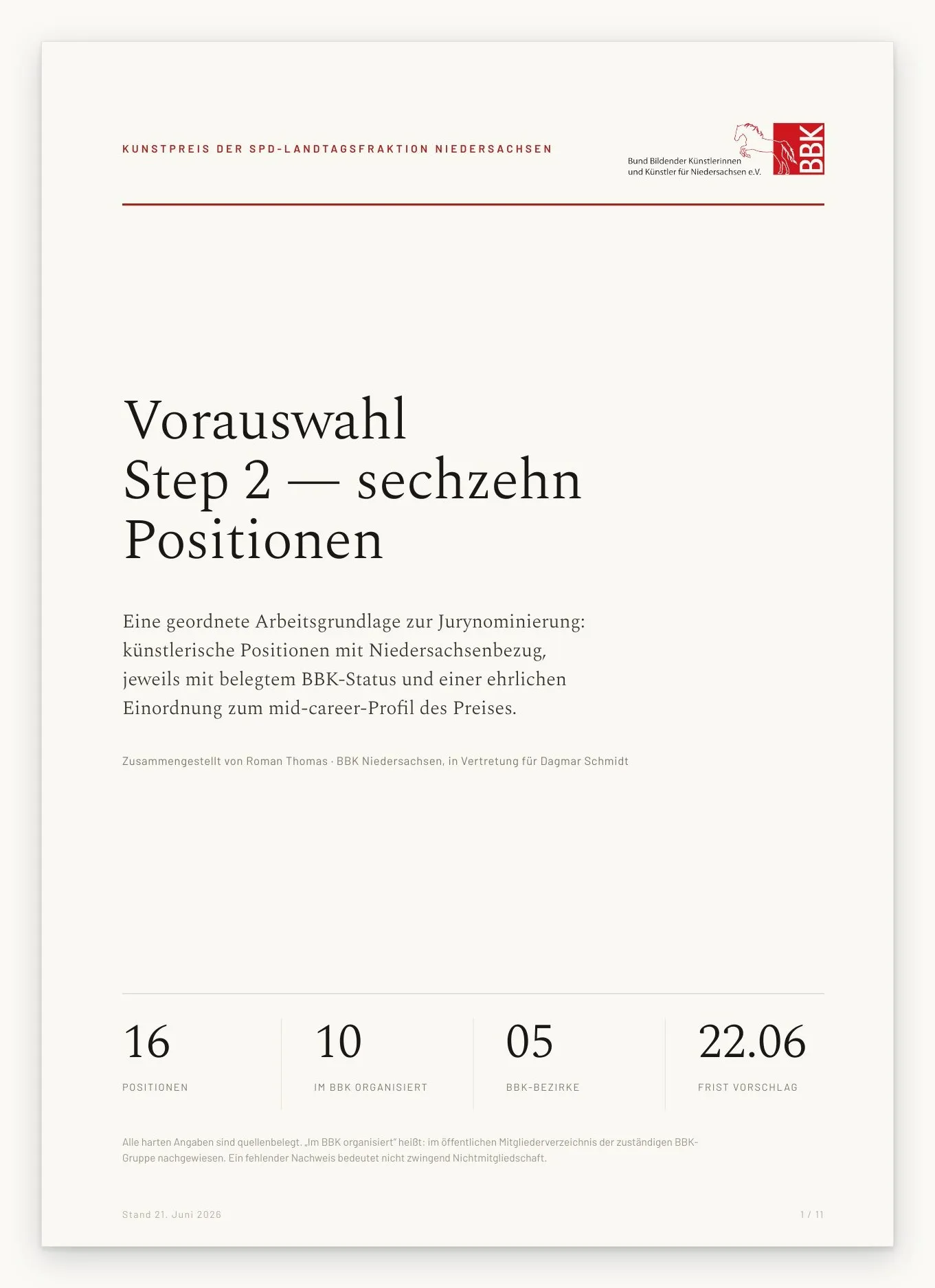
None of this happened alone at my desk. I sat on the jury standing in for Dagmar Schmidt, chair of the BBK Lower Saxony, and the state association was meant to know at all times where we stood. After the first session a status report went to her on June 2: who sits on the jury, what was decided and what comes next.
And between the individual phases we met in person in Hanover again and again, about the state of the research and about our own selection. It took time, and that was right. I sat there for the association, so I talked to the association. That is why the cover of the shortlist carries this one line: compiled on behalf of Dagmar Schmidt.
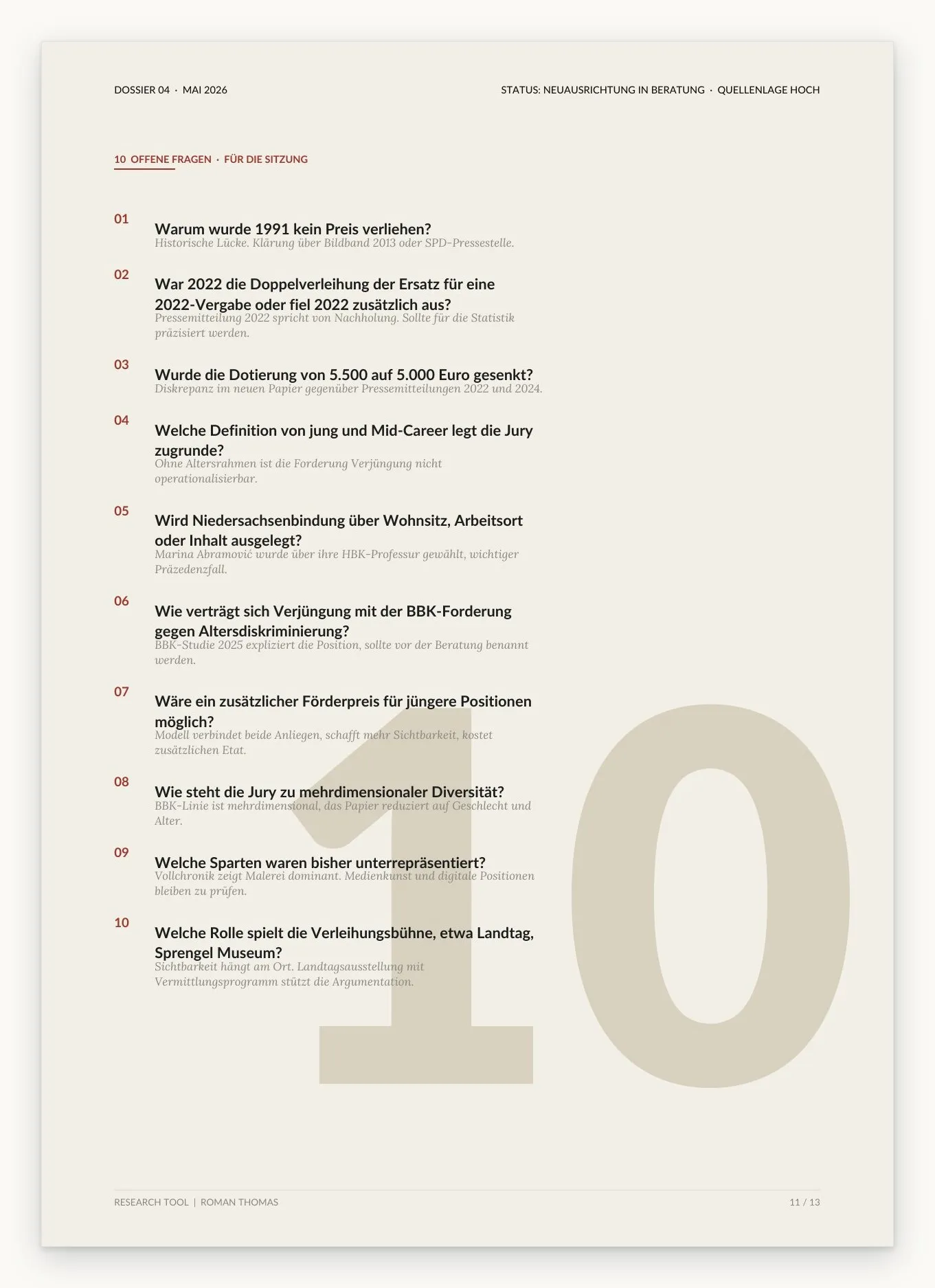
One page from my first dossier is still a favourite. It has no answers, only ten questions. Why was no prize awarded in 1991? What does the middle of a career mean if there is no age limit? Is exhibiting in Lower Saxony enough, or do you have to live here? The first session answered some of them.
Research also means marking honestly where knowledge ends. Knowing what you don't know is part of it.
In the end I submitted two names. On July 2 they lay next to the proposals of the others, and the prize went to a position I had not proposed. That was no failure of the research. I could take part in the discussion because I knew what the situation in Lower Saxony looks like.
What occupied me most in this work are the many who in the end were not on the table. I read their websites, traced their paths, looked at their work. You owe that thoroughness to those you don't propose, too. On October 6 the prize will be presented at the Sprengel Museum Hanover, and I am looking forward to it.